Digitization

Digitization in the office


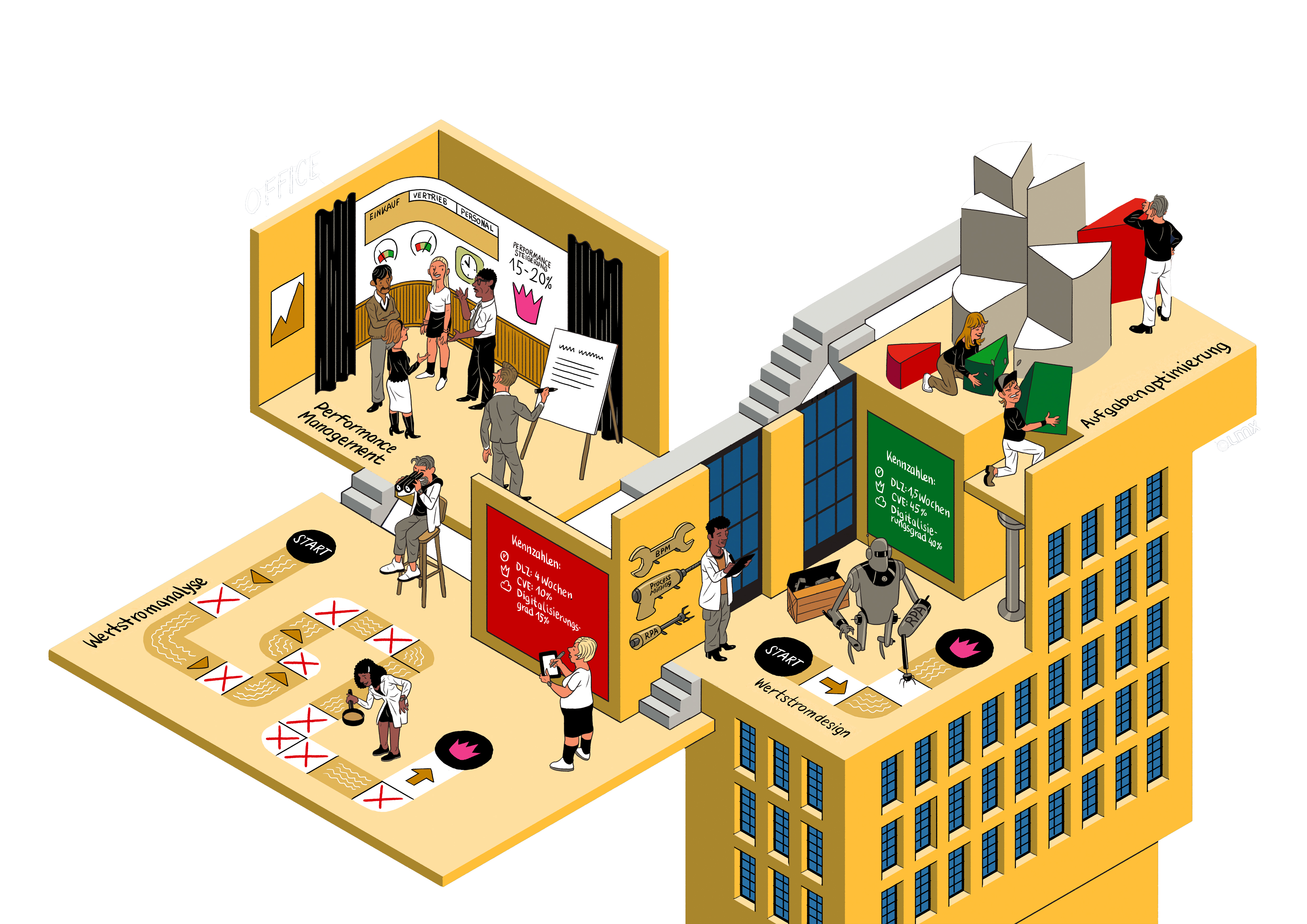
Digitize and automate processes to fit
Your Partner

Digitization in the office

By digitization in the office, we mean on the one hand the transformation from analog to digital information flows and virtual collaboration in distributed teams.

From analog to digital

To implement the basic principle of "creating value without waste," digitization and automation solutions can help. Basically, we follow the principle of "optimize first, then automate". In our projects, we rely on digitization solutions that bring real added value to our customers to support analysis and implementation.

Judith Fellsches
Managing Partner

Phone: +49 211 63 55 89 60
Email: info@lmx.eu


Lean Management & Digitization 2026 at Ruhr-University Bochum

Business Process Management (BPM) Software

In addition to the proven value stream analysis for information flows, we document the actual value streams in the BPM tool and use the advantages of the software, such as the calculation of throughput times, capacity commitment per function or the calculation of a degree of digitization. After the optimization in the workshop, we also model the target process in the tool and can thus also make quick comparisons. In addition, the implementation of the new process is supported by the BPM software, as everyone can easily view the new process or comment on it, for example. The registered process owner is reminded after the expiration of the validity, which supports the continuous review.

Your added value

  • We advise you if a Business Process Management Software is helpful for your problem
  • For your project we bring the software - benefit from the enhanced value stream mapping and design without the risk and constraint of purchasing a new software. A transfer into your existing BPM software solution is no problem thanks to the BPMN 2.0 standard - of course a modeling in your system is also possible.
  • You are looking for a BPM software? Benefit from our expertise and our structured approach to select a BPM software that involves all stakeholders and thus significantly increases the acceptance.

Process Mining

Process Mining Software visualizes processes based on IT transaction data. We leave our "footprints" (transaction data, log data) in IT systems with every IT system-supported activity. This data is collected and processed by the process mining software. We complement our value stream analysis with process mining and thus obtain a very high level of objectivity and detail without losing sight of the end-to-end process.

Your added value

  • We advise you whether process mining is helpful for your problem definition.
  • We bring the software for your project - benefit from the enhanced value stream mapping and design without risks and the need to purchase new software.
  • We can translate business requirements into IT specifications because we have a very strong understanding of processes and a high affinity for IT. 

Robotic Process Automation (RPA) and Low Code Programming

Processes that are frequently repeated and run according to very clear rules lend themselves to automation with so-called "bots. Here, we continue to follow the lean way of thinking, because automated waste remains waste. Especially "bots" and smaller automations can be realized via different software solutions. We would like to realize the best possible result for you and this with board means if possible. We check whether software solutions, e.g. in the Office 365 environment, are suitable for implementation in your company before we start thinking about new software solutions. To ensure a long-term effect, we consider not only the one-time effort to create the bot but also the operational processes such as change request management and maintenance when identifying suitable sub-processes. The independent automation of processes by the specialist departments brings with it many added values, but also involves the risk of a "proliferation" of solutions. This "uncontrolled growth" can lead to considerable additional work, for example, if a source system is adapted and the automation no longer works - but no one notices this at first. Therefore, in our projects we pay attention to the highest possible flexibility while ensuring sustainability.

RPA film

Your added value

  • We identify with you the suitable sub-processes for RPA
  • Increase employee satisfaction by relieving them of repetitive and boring processes

Visualization with dashboards

Visual management is very important, especially in administration, as information must first be made visible. We embed dashboards in office floor management because regular discussion of key figures and deviations are the basis for continuous and targeted improvement. We have developed a structured approach to identify the right metrics and make them available on a dashboard. For this we use your existing tool or bring a solution. The approach involves the users of the dashboard and thus ensures that you get to the improvement quickly instead of discussing data origin, validity and timeliness.

Your added value

  • Create transparency based on numbers, data and facts
  • Establish holistic deviation management instead of just presenting key figures
  • Sometimes less is more - visualize correctly to see the important immediately

Virtual collaboration

We design about 50% of our projects and trainings without being on site with our customers. We value the direct exchange very much and now know when it is essential to ensure project or training success. Virtual collaboration requires adapted approaches and even stronger visualization to keep team performance high. Tools for collaboration, task control and organization are as important as the right behaviors and rules of collaboration.

We have built up a large portfolio of approaches, tips and tools, which we teach in trainings and apply in our projects.

LMX Barometer

Determine regularly how well virtual collaboration is working

Virtual value stream mapping and design

With the help of digital whiteboard solutions, the proven methodology can be carried out with participants distributed around the globe.

Facilitation of virtual workshops and trainings

Conduct varied and interactive workshops digitally

You can also participate remotely in many of our trainings.

Digital driver's license

For all managers who

  • want to manage a distributed team
  • want to shape digital collaboration
  • want to participate confidently in digital collaboration

FAQ: Digitalization

Specific search query: What does digitalization mean for companies?

Digitalization means the systematic use of digital technologies to make processes, information, and collaboration more efficient, transparent, and customer-oriented. It is not simply about replacing paper with software or mapping existing workflows electronically. Successful digitalization challenges existing processes and creates the foundation for better decisions, faster response times, and higher productivity.

Many companies primarily associate digitalization with technology. In reality, however, successful digitalization begins with a clear understanding of internal processes and customer requirements. Only when it is clear where waste, media breaks, or unnecessary complexity arise can digital solutions deliver their full value.

Today, digitalization affects nearly every area of a company: production, administration, sales, procurement, human resources, and service. The goal is to make information available faster, simplify routine tasks, and make the organization more adaptable overall. Successful digitalization therefore not only improves processes, but also strengthens a company’s competitiveness and capacity for innovation.

Specific search query: How digital are our processes?

Many companies consider their processes digital because they use modern software. On closer inspection, however, media breaks, duplicate data entry, manual exports, or numerous coordination loops between departments often become apparent.

The degree of digitalization in a process does not depend on how many systems are used, but on how efficiently information flows and decisions can be made. A fully digital form provides little benefit if manual checks, emails, or follow-up questions are still required afterward.

To assess the level of digitalization, companies should analyze how information is created, processed, and used. Important questions include: How much manual effort is involved? Where do waiting times occur? What data is available for decision-making? Which steps could be automated or simplified?

This often reveals that the problem is not a lack of technology, but inefficient processes. For this reason, digitalization should always be considered together with Lean Management, starting by creating transparency around actual workflows.

Specific search query: When is digitalization worthwhile?

Digitalization is worthwhile whenever it creates concrete value for customers, employees, or the organization. Examples include shorter lead times, fewer errors, less administrative effort, greater transparency, and faster decisions.

Many companies invest in new software or automation solutions without understanding the root causes of their problems. As a result, existing weaknesses are often merely digitalized. Sustainable improvements, by contrast, arise when processes are first understood and then supported digitally in a targeted way.

Particularly significant potential often exists in areas with many manual tasks, media breaks, recurring decisions, or complex information flows. In these areas, digitalization can help free up resources and relieve employees of routine tasks.

However, not every problem can be solved through digitalization. In many cases, the greatest improvement first comes from simplifying or standardizing a process. Only then should companies evaluate which digital technologies provide the greatest added value.

Specific search query: Optimize first or digitalize right away?

One of the greatest forms of waste is digitalizing or automating inefficient processes. Digitalization accelerates workflows, but it does not automatically improve their quality or purpose. If a process contains unnecessary loops, waiting times, or duplicate work, digitalization often only makes these problems visible faster or even amplifies them.

That is why Lean Management follows the principle: “Optimize first, then digitalize.” The first step is to analyze which activities truly create value and which steps can be simplified or eliminated. The next step is to determine how technology can support the improved process.

This approach reduces investment risk and increases the likelihood that digitalization will deliver measurable results. Companies benefit from more efficient processes, greater employee acceptance, and a better return on investment.

Digital technologies are therefore not an end in themselves. They create the greatest value where lean, customer-oriented, and stable processes are already in place.

Specific search query: Which processes should I digitalize first?

Processes with a high share of recurring tasks, clear decision rules, and extensive data processing are especially well suited. Examples include quotation processes, invoice processing, order processing, document management, HR processes, and standardized service requests.

Processes with many media breaks or manual transfers also often offer significant potential. If information must be entered multiple times, gathered from different systems, or regularly forwarded by email, digitalization can enable substantial efficiency gains.

However, selection should not be based solely on technical feasibility. The expected value and strategic importance to the company are decisive. Processes with a strong impact on customers or high resource consumption should generally be prioritized.

A structured approach begins with an analysis of processes, existing data, and current challenges. This allows companies to identify the areas where digitalization creates the greatest added value.

Specific search query: Where is digitalization worthwhile in a company?

Digitalization potential becomes visible when companies systematically analyze their processes, information flows, and decision paths. Typical indicators include long processing times, high error rates, many follow-up questions, media breaks, or a high level of administrative effort.

Activities that are frequently repeated, create little value, or create strong dependencies on individual people are especially relevant. Processes that are managed based on incomplete data also often offer significant opportunities for improvement.

In addition to traditional process analyses, data-based approaches such as process mining and AI-supported evaluations are becoming increasingly important. They help make actual workflows visible and objectively identify weaknesses.

The right perspective is essential: the focus should not be on technology, but on how customer value can be increased, employees can be relieved, or decisions can be improved. From this perspective, digitalization potential often emerges almost automatically.

Specific search query: Digitalization or automation — what is the difference?

Digitalization and automation are often used interchangeably, but they describe different things. Digitalization means converting analog information, processes, or ways of working into digital forms. Automation goes one step further and has systems or software take over specific tasks or decisions.

A digital form, for example, is a result of digitalization. If the information is then automatically processed, checked, and forwarded, automation is also involved.

For companies, this distinction is important because automation is only successful when the underlying processes are designed effectively. Otherwise, there is a risk of automating unnecessary work.

Lean Management helps by first creating transparency around processes and reducing waste. Only then should companies decide which steps should be digitalized or automated. This creates solutions that are not only faster, but also more effective.

Specific search query: Why is data so important for digitalization?

Data forms the foundation of successful digitalization. It creates transparency around processes, supports well-informed decisions, and provides the basis for automation and the use of Artificial Intelligence (AI).

Many companies today have large amounts of data, but use it only to a limited extent. Information is spread across different systems, incomplete, or not current enough for effective management.

The real added value does not come from the volume of data, but from its quality and usability. Good data helps make bottlenecks visible, identify developments early, and make fact-based decisions.

Data-driven organizations often respond faster to change and are better able to continuously improve processes. Digitalization should therefore always also answer the question of what information is needed for decisions and how that information can be made reliably available.

Specific search query: How do I connect existing IT systems with one another?

Most companies already have a wide range of IT systems. ERP solutions, CRM systems, document management, workflow platforms, and business intelligence tools often exist side by side. The challenge is therefore often less about introducing new systems and more about integrating them effectively.

Successful integration ensures that information is available where it is needed. Duplicate work, media breaks, and manual data transfers can thereby be significantly reduced.

Before technical implementation, however, business processes should be analyzed. Only when it is clear what information is needed, when it is needed, and which decisions should be supported can a meaningful system architecture be created.

The focus should not be on creating as many interfaces as possible, but on end-to-end information flows. The goal is a digital work environment that supports employees rather than creating additional complexity.

Specific search query: How can digitalization succeed over the long term?

Sustainable digital transformation is far more than the introduction of new software. It connects technology, processes, leadership, and employees into a holistic change process. Successful companies therefore do not view digitalization as an IT project, but as part of their organizational development.

Critical success factors include a clear target vision, employee involvement, and consistent alignment with customer value. At the same time, leaders must provide direction and actively support change.

Organizations that combine Lean Management and digitalization are especially successful. Lean creates transparency, stable processes, and a culture of continuous improvement. Digitalization and Artificial Intelligence (AI) build on this foundation and enable faster analyses, better-informed decisions, and more efficient workflows.

Sustainable digital transformation therefore does not result from technology alone. It emerges where people, processes, and digital opportunities work together effectively and create lasting added value for customers and the organization.