Digitization

Smart Factory


Use technology for waste-free processes and optimal support for people
Your Partner

Smart Factory

With a Smart Factory, we pursue the target of achieving waste-free processes and optimal support for people through modern production systems, new automation technologies, the use of data and its provision via assistance systems. Technology is not used as an end in itself, but to meet real existing needs and further increase your company's success.

Smart Factory Transformation starts with the structuring of processes and increases their transparency, effectiveness and efficiency.

"Bad processes remain bad processes, even if they are digitized."

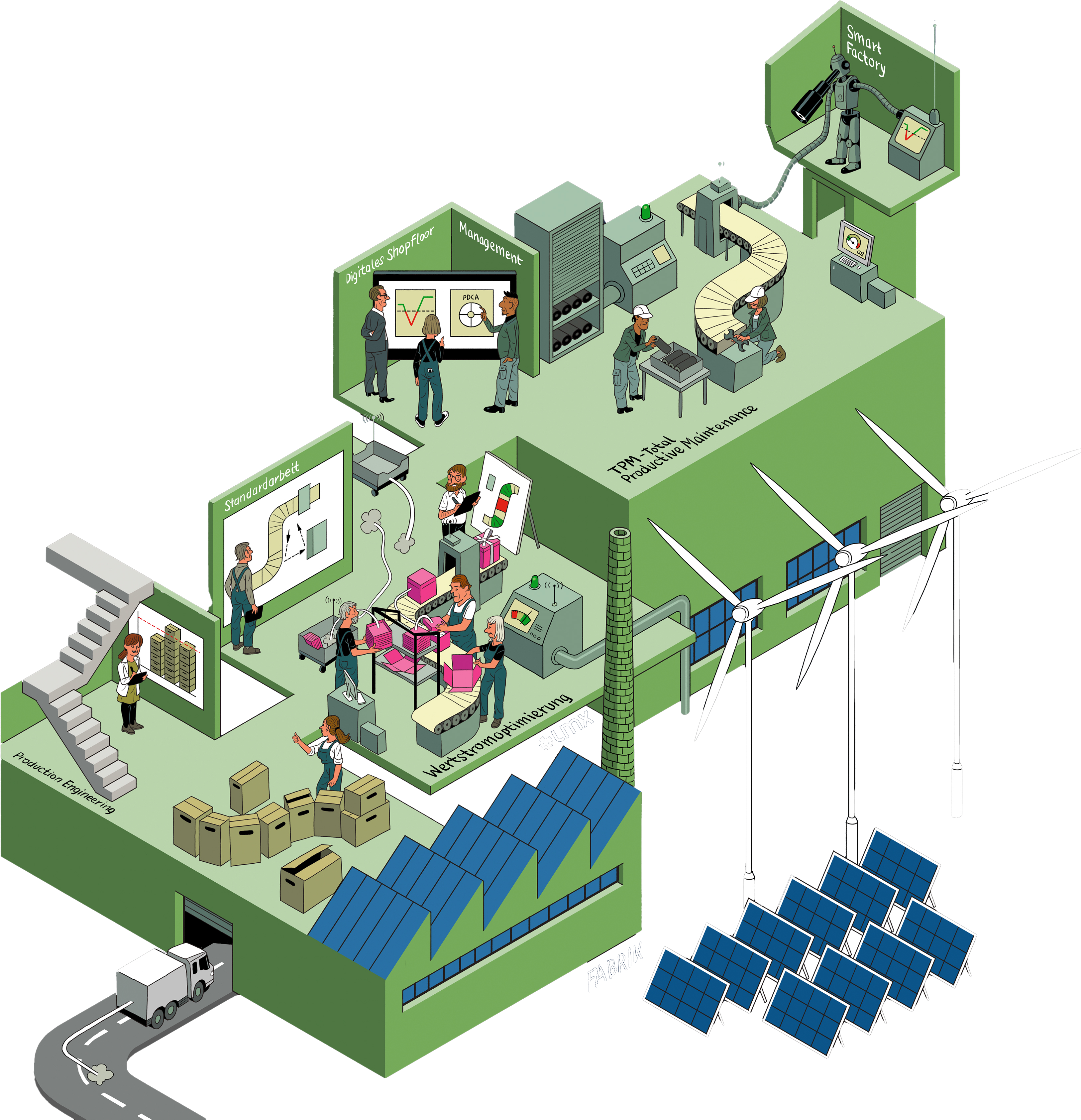
Target image Smart Factory

The technological starting points are many and varied and can be broken down into four areas: data acquisition and use, future-proof production systems, new automation and the connection of people. Each of these fields is subject to continuous innovations in the context of Industry 4.0, which enable new forms of transparency, collaboration and human-technology interaction. Let's unleash the digital potential of your production together.

Digitize your production holistically

An Industrie 4.0 transformation can be clustered into the topics of digitalization of production, digitalization of products and data-based business models. In this context, LMX focuses specifically on consulting for the digitization of production and the associated question of what the smart factory of the future can look like in concrete terms for the companies it supports.

The LMX approach combines the three core elements of a future-oriented production system: technology, organization/processes and people. Only through a coordinated interplay of these three core elements can the full value creation potential of digitalization be activated. As an implementation-oriented consultancy, we accompany you through all phases, from the identification of a common understanding of the topic, through your personalized vision and roadmap, to the utilization phase.

CONTACT

We look forward to your questions, suggestions and requests and will contact you as soon as possible.


Christian Jagla
Partner

Alexander Schnichels
Senior Consultant

Phone: +49 211 63 55 89 60
Fax: +49 211 63 55 89 69
Email: info@lmx.eu


Lean Management & Digitization 2026 at Ruhr-University Bochum

Target-oriented

Our solutions

We bring extensive experience in various core competencies for practice-oriented support on your way to the Smart Factory

Value Stream Management

With Value Stream Management for Smart Factories (VSM4SF) in 8 steps to the targeted optimization of the entire order-to-delivery process. This includes the information logistic types of waste as well as the survey of the "digital" quality of the value stream with the help of the digitalization KPI.

Digitales Shopfloor Management and Dashboarding

Shopfloor management is a management tool in production to make the current status of production transparent. It is visualized via team boards, where the most relevant key figures are discussed regularly (usually daily).

Smart Factory Maturity Assessment

Based on the corporate strategy and vision as well as the existing systems and technologies, we evaluate the status quo in terms of technology, organization and people and develop a target picture. A roadmap for targeted digitization is the result

Assistance systems

Together with you, we look at which assistance systems can make your production more effective. In six steps we analyze the application potential of various assistance systems for the task to be assisted and accompany the system selection up to the utilization phase.

Smart Factory Vision, Strategy and Roadmap

We work with you to develop the Smart Factory vision and derive from it the long-term strategies and a roadmap for 12-24 months with concrete measures. If required, a Smart Factory Maturity Assessment can be carried out in advance.

Automation

Using our quick check, we evaluate tasks with regard to their suitability for automation. Here, we take into account the number of pieces and product variance to determine the right degree of automation (MRC, robot, fixed automation).

Smart Maintenance 

Intelligent maintenance takes into account digitization, monitoring and automated evaluation of production plants and buildings as well as the technical infrastructure of companies.

Shopfloor IT Systems

The status quo of your IT landscape consisting of data sources, middleware, databases up to data usage is analyzed and visualized. A VSM4SF can be helpful in creating transparency. We accompany you in setting up store floor management and digitization from system selection to the utilization phase.

Retrofitting

The modernization of machines and plants enables the optimization of production and the creation of added value even with older systems. With the help of retrofitting, relevant data from older systems can be collected without direct access to the machine control. We support the evaluation and accompany an implementation.

Smart Factory Trainings & Tours

We offer various open and in-house trainings on the topic of Smart Factory. Our portfolio ranges from the Awareness Session to the Smart Factory Master and can be customized to your needs. See our open training program.

FAQ: Smart Factory

Specific search query: What is a Smart Factory in simple terms?

A Smart Factory describes a connected and intelligent production environment in which machines, equipment, products, and employees are linked and exchange information in real time. The goal is to make production processes more transparent, flexible, and efficient.

The Smart Factory is a central component of Industry 4.0. Modern sensors, data platforms, automation, Artificial Intelligence (AI), and digital control systems help teams make decisions faster and based on current information.

However, it is important to note that a Smart Factory is not created through technology alone. The real benefit emerges only when data is used deliberately to improve processes, identify problems faster, and support employees in their work.

From LMX’s perspective, Lean Management forms the foundation of a successful Smart Factory. Only when processes are understood, standardized, and designed with minimal waste can digital technologies realize their full potential. The Smart Factory is therefore not primarily a technology project, but the further development of a high-performing production system.

Specific search query: What are the benefits of a Smart Factory?

A Smart Factory enables companies to respond more quickly to change, manage production processes with greater transparency, and make decisions based on real-time data. As a result, productivity, quality, and on-time delivery can be improved sustainably.

By connecting machines, systems, and processes, companies gain much better insight into the current state of production. Deviations are detected earlier, maintenance can be planned in advance, and production workflows can be optimized.

Another benefit is greater flexibility. Companies can produce smaller batch sizes more economically and respond more quickly to customer requirements. At the same time, employees are supported by digital information and relieved of manual data entry.

The greatest potential often comes not from individual technologies, but from the combination of Lean Management, digitalization, data analysis, and automation. This gives companies the foundation for future-ready production that is both efficient and adaptable.

Specific search query: How do you become a Smart Factory?

Many companies believe that the path to a Smart Factory begins with major investments in new technologies. In practice, however, a different approach is more successful. The first step is to create transparency around existing processes and challenges.

Companies should first analyze where bottlenecks, quality problems, waiting times, or missing data occur. Next, they define specific improvement goals. Only then should they decide which digital technologies will actually deliver added value.

A step-by-step approach using pilot areas has proven effective. Instead of digitalizing the entire production operation at once, companies identify and test initial use cases. The lessons learned can then be transferred to additional areas.

What matters is that the Smart Factory is not viewed as a purely IT-driven project. Successful companies combine Lean Management, employee training, digitalization, and automation into a holistic transformation approach.

Specific search query: What data does a Smart Factory need?

Data are the foundation of every Smart Factory. They make it visible what is currently happening in production and enable well-founded decisions based on facts rather than assumptions.

Machines, equipment, sensors, and IT systems continuously generate information about production volumes, quality, disruptions, energy consumption, or utilization. These data can be used to monitor processes, identify bottlenecks early, and systematically uncover opportunities for improvement.

What matters, however, is not the volume of data, but their usability. Many companies already have large amounts of data, but they are not evaluated consistently. A Smart Factory therefore focuses on the information that is truly needed for decisions.

The goal is to create transparency and provide employees and managers with exactly the information they need to manage production effectively.

Specific search query: How do I integrate old machines into Industry 4.0?

Yes. Many companies have machines and equipment that have been in use for years or even decades. This brownfield equipment can often still be integrated into a Smart Factory.

Modern sensors, edge devices, or retrofit data-capture solutions make it possible to collect important information from existing equipment and make it digitally available. This allows companies to benefit from a Smart Factory without having to replace their entire machine fleet.

The first key question is which information is actually needed. Not every machine has to be fully connected. Often, selected data such as run times, disruptions, energy consumption, or production volumes are enough to create significant added value.

Integrating existing equipment is therefore one of the most common use cases on the path to a Smart Factory and often offers attractive economic potential.

Specific search query: Do you need Lean Management for a Smart Factory?

Lean Management forms the foundation of a successful Smart Factory. Digital technologies can accelerate processes and make them more transparent. However, they do not automatically solve existing process problems.

When waste, unclear responsibilities, or unstable processes exist, digitalization often merely makes them visible—or even amplifies them. That is exactly why the principle also applies in the Smart Factory: optimize first, then digitalize.

Lean Management creates stable processes, clear standards, and a consistent focus on customer value. On this basis, data, automation, and Artificial Intelligence (AI) can deliver their full benefit.

Companies that combine Lean and Smart Factory approaches often achieve significantly better results than organizations that rely solely on technology. The Smart Factory therefore does not begin with sensors or software, but with the design of high-performing processes.

Specific search query: How is AI used in the Smart Factory?

Artificial Intelligence (AI) helps the Smart Factory automatically evaluate large volumes of data and identify patterns that would be difficult for people to see.

Typical use cases include predicting machine failures (predictive maintenance), optimizing production plans, monitoring quality, and analyzing production data. AI can help companies respond more quickly to deviations and make better-informed decisions.

However, it is important that AI not be introduced in isolation. The best results occur where high-quality data, stable processes, and clear responsibilities are in place.

From LMX’s perspective, the greatest benefit of AI lies in significantly accelerating analyses. This allows problems to be identified earlier and improvements to be implemented faster. The goal is not full automation, but effective support for employees and managers.

Specific search query: What does predictive maintenance mean?

Predictive maintenance describes the forward-looking maintenance of machines and equipment. Instead of performing maintenance at fixed intervals or waiting for a failure, condition data are continuously monitored and analyzed.

Sensors capture data such as temperature, vibrations, run times, or energy consumption. Based on these data, early indications of possible wear or disruptions can be detected.

This allows maintenance activities to be planned more precisely and unplanned machine downtime to be reduced. Companies benefit from higher equipment availability, lower maintenance costs, and better production planning.

Predictive maintenance is one of the best-known Smart Factory applications and clearly shows how data and digitalization can create direct economic value.

Specific search query: Why do Smart Factory projects fail?

Many Smart Factory projects fail not because of the technology, but because of a lack of strategy, unclear goals, or insufficient process maturity. New systems are often introduced without a sufficient understanding of the actual problems in production.

Additional challenges include poor data quality, insufficient employee training, silo thinking between departments, and the lack of integration between existing IT and production systems.

Cultural factors also play an important role. Employees need to understand the benefits new technologies provide and how they support daily work. Communication and training are therefore essential success factors.

Successful companies begin with clearly defined use cases, create transparency around their processes, and introduce technologies step by step. This creates a sustainable transformation rather than an isolated technology project.

Specific search query: How can you recognize a Smart Factory?

A successful Smart Factory is not recognized by the number of sensors, dashboards, or digital systems. What matters is the actual benefit for customers, employees, and the company.

Typical characteristics include high transparency across processes, data-based decisions, fast responsiveness, and close integration of people, processes, and technology. Problems are identified early and solved systematically.

In addition, successful Smart Factories have stable Lean processes, qualified employees, and a culture of continuous improvement. Technology is used deliberately to improve decisions and increase value creation.

Ultimately, success is reflected in concrete results: shorter lead times, higher productivity, better quality, lower inventories, higher on-time delivery, and greater flexibility in responding to customer requirements. That is where the true added value of a Smart Factory lies.